 Bayshore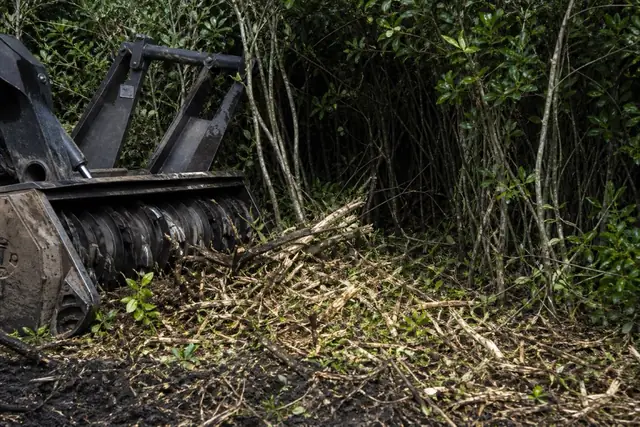
Bayshore Land Clearing puts Pasadena property owners in front of a local land clearing contractor for yaupon thicket clearing in Pasadena and the bayshore cities around it.
Yaupon holly is a Texas native with no manners about boundaries. Left unmanaged on the moist eastern side of Harris County it grows as a multi-stem evergreen thicket dense enough to stop a person, swallow a fence, and shade out everything beneath the oak canopy. Old-timers along the Gulf Coast talk about yaupon 'walls,' and anyone who has tried to push through one understands why the word fits.
Clearing yaupon is mostly a mulching job. The stems are rarely thick — the problem is their number — and a mulching head eats a packed thicket at a steady walk, converting it to chips without disturbing the live oaks and hackberries standing over it. Where an owner wants the thicket gone at the roots, an excavator grubs the crowns out instead, trading a rougher finish for slower regrowth.
The transformation is dramatic because yaupon hides so much. Parcels open up by what feels like double the acreage; drainage swales nobody remembered reappear; and the specimen trees that were fighting the thicket for light get their understory back. For bayshore lots where a water view is the whole point of the property, a yaupon pass is often the cheapest view improvement available.
A native that behaves like an invader
Botanically, yaupon (Ilex vomitoria) belongs here — the profile at USDA PLANTS maps it across the whole coastal South. What changed is the landscape around it. The tallgrass prairie that once burned regularly kept woody cover pinned to the bayou margins; decades of fire suppression handed yaupon the run of any unmowed ground. That history matters for management: this is a plant the land encourages, so clearing plans have to assume it will keep trying.
It also means selective clearing is a legitimate choice. Yaupon is evergreen, screens well, and feeds wintering birds — wildlife guidance from Texas Parks & Wildlife lists it among the useful cover species. Plenty of Pasadena-area owners keep a yaupon hedge on the property line and clear the interior, getting privacy and usable ground from the same job.
Mulch it or grub it: choosing by what comes next
Cut yaupon re-sprouts from the root crown, so the method should follow the parcel's future. Ground headed for pasture, mowing, or periodic maintenance does fine with mulching — the annual pass handles sprouts. Ground headed for a homesite, septic field, or landscaping is better served by grubbing the crowns, since buried live roots under a finished yard turn into a whack-a-mole problem. Brush-management research from Texas A&M AgriLife is blunt that top removal alone does not finish resprouting species.
Grubbing on gumbo clay carries its own caveat: every crown that comes out brings a root ball of clay with it, leaving divots that hold water on a flat parcel. A complete quote for grubbed yaupon includes knocking those divots back flat — ask for that line item, because on this prairie a pockmarked surface becomes a mosquito farm by June, a point the Harris County mosquito-control folks make every wet season.