 Bayshore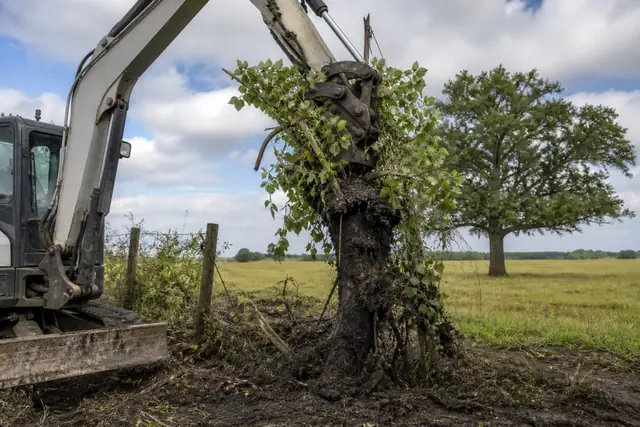
Bayshore Land Clearing puts Pasadena property owners in front of a local land clearing contractor for Chinese tallow removal in Pasadena and the bayshore cities around it.
Ask anyone who manages land between the Ship Channel and Galveston Bay to name the enemy and the answer is the same: Chinese tallow, the 'popcorn tree,' with its heart-shaped leaves and white waxy seeds. Introduced deliberately a century ago and spread by birds and floodwater ever since, tallow converts open coastal prairie into monoculture woodland faster than any native competitor — a lot left idle since Hurricane Harvey can already be carrying a closed tallow canopy.
Removal is a solved problem mechanically. Saplings mulch by the hundred; mature multi-trunk trees come down with a saw or get pulled whole with an excavator, roots and all, out of soft clay. The part that separates a real removal from an expensive haircut is what happens at the stump, because a sawn tallow stump left untreated sends up a ring of sprouts that outgrows the original tree's height in two or three seasons.
That is why quotes for tallow work on this site are written with the end state named: knockdown only, knockdown with stump treatment, or full grubbing with roots out of the ground. Each has a price and a regrowth expectation, and an owner who knows which one they bought is never surprised the following June.
Why tallow owns the idle acres of the bayshore
The species profile at Texas Invasives reads like a design brief for conquering this exact landscape: thousands of bird-carried seeds per tree, tolerance for both drought-cracked and waterlogged clay, no local insect pressure, and vigorous resprouting when damaged. On the prairie pockets that survive around Armand Bayou, land managers treat tallow as the primary threat to the tallgrass system — the preserve's stewards at the Armand Bayou Nature Center spend a real share of their effort holding it back.
For a private owner the takeaway is unsentimental: every mature tallow on the parcel is a seed source reloading the neighborhood, and removal earliest is removal cheapest. A sapling flush mulches for pocket change; the same cohort ten years on is a canopy-scale extraction with machinery to match.
Getting removal to actually stick
The regional restoration playbook — used by groups like the Galveston Bay Foundation on their marsh and prairie projects — pairs mechanical removal with immediate treatment of every cut surface, then a follow-up walk the next growing season for seedlings and missed sprouts. Private parcels succeed the same way: the second visit is short and cheap, and it decides whether the lot stays cleared or the thicket merely takes a year off.
Where trees are pulled rather than cut, the root pits need attention before the job is called done. On flat Pasadena clay a grubbed pit holds rain for weeks, so finished tallow extraction includes backfilling and rough-grading the holes — and on bigger removals it is worth discussing what native cover goes in behind it, since bare disturbed clay is exactly the seedbed tallow prefers. Replanting guidance for Gulf Coast conditions is available through Texas A&M AgriLife Extension.