 Bayshore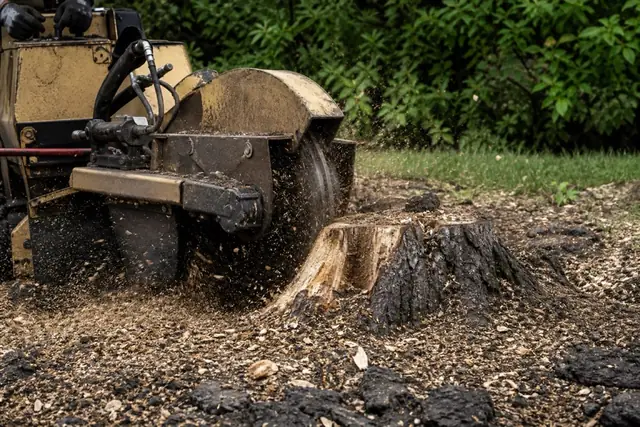
Bayshore Land Clearing puts Pasadena property owners in front of a local land clearing contractor for stump grinding in Pasadena and the bayshore cities around it.
Every tree that comes down on the bayshore leaves its stub in the lawn — a mower-blade hazard, an ankle-catcher, and, when the tree was a tallow, a thing still actively plotting its comeback. Grinding is the standard cure for stumps in finished yards, where an excavator would wreck more lawn than the stump is worth. A toothed wheel works down through the wood from the top, typically finishing eight to twelve inches under the surface, deep enough to cover the hole with soil and mow straight over it.
Species changes the job more than owners expect. Hackberry and tallow grind fast and soft; live oak is dense and slow and priced accordingly; and old multi-stem yaupon or ligustrum crowns are less one stump than a knotted plate of them. Diameter is measured at the widest flare, not the trunk — that flare is most of the grinding time on a mature tree.
On freshly cleared parcels, grinding competes with grubbing and usually splits the work: grub the open areas where a machine can pull stumps wholesale, grind the ones near fences, slabs, pools, and property lines where extraction would collateral-damage things that matter. A quote through this site prices both methods so the split lands where the parcel wants it.
What happens under the lawn after grinding
Grinding removes the stump, not the root system — the buried roots decay in place over years, and the chip-filled crater needs managing. Chips mixed into the backfill rob nitrogen as they rot, which is why grass over a lazily-filled grind pit comes in yellow and sunken a year later. The fix is cheap and standard: excess chips raked off, the hole filled with actual soil, slightly crowned for settling. Lawn-establishment guidance from Aggie Horticulture covers re-turfing the patch for Gulf Coast grasses.
Two species notes for this county: tallow stumps should be ground promptly and watched for sprouts from surviving lateral roots — persistence is the species' whole personality, as its invasive-species profile documents. And where a big tree stood within a few feet of a slab or walk on expansive clay, the decaying root zone can settle unevenly for several seasons; keeping the area watered evenly moderates the clay movement underneath.
Grinding day: access, utilities, and what to point out
A self-propelled grinder fits through a standard gate, but it still wants a clear route — and it absolutely wants to know what's buried. Irrigation lines, low-voltage wiring, septic laterals, and shallow utilities all live in the same top foot of soil the wheel works in, so the 811 locate plus an owner's walk-through of known lines is part of a professional job, a practice utility-safety programs across Texas, including state environmental regulators, uniformly encourage.
Point out sprinkler heads, the dog fence, and anything sentimental within chip-throw range; grinders sling debris, and good operators screen or reposition to protect glass and vehicles. If the stump sits on a property line, settle whose it is before the appointment — a five-minute conversation that has saved many a fence-line friendship. Storm-planning material from the Texas A&M Forest Service is also worth a read when deciding which remaining trees are worth keeping over the slab.