 Bayshore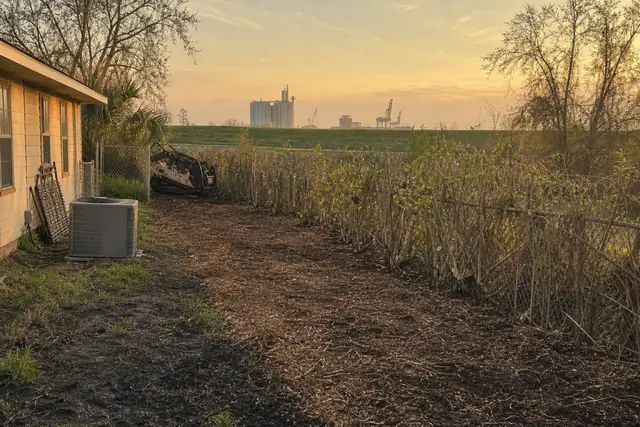
Bayshore Land Clearing puts Galena Park property owners in front of a local land clearing contractor for forestry mulching, brush removal, and site prep across the Galena Park area.
Galena Park is the Ship Channel in residential form: 10,740 people (2020 census) in a town that grew up with the docks, where the horizon is grain elevators and channel cranes and the streets carry four generations of longshore and plant families. Its clearing needs are the honest basics — fence lines lost to tallow, back lots gone to brush, the occasional vacant parcel that needs bringing back to mowable.
The town's position, tucked against the channel and its levee lines, gives the work a particular texture. Lots end at industrial boundaries and drainage rights-of-way more often than at another backyard, and knowing exactly where private ground stops is part of quoting the job correctly. Inside those lines, it's standard prairie-lot work on the same black clay as everywhere on the shelf — mulch the thicket, clear the corridor, keep the water moving.
Clearing against industrial boundaries
Where a residential parcel backs onto rail, terminal, or channel-adjacent land, clearing stops at the surveyed line no matter what the brush thinks — vegetation ignores boundaries, machines can't. Fence-line jobs in Galena Park often start by physically finding that line in the thicket, then clearing the private side to a maintainable corridor. The buffer of daylight that results is its own benefit: visible fences, patrollable edges, and no more mystery about where the property ends. Boundary-adjacent drainage stays open toward the systems Harris County Flood Control manages around the channel.
Air-quality-conscious neighbors and active industrial monitoring also make this the wrong town for anyone's burn pile. Mulch-in-place methods sidestep the whole question, consistent with the state's outdoor-burning restrictions administered by the TCEQ.
Small-town lots, big-storm drainage
Galena Park's flat blocks drain through a modest network of ditches and storm lines that only works when it's open. Brush that colonizes a back-lot swale or side ditch quietly disables it, and the next tropical downpour finds the weak point — this is a county whose flooding history, chronicled by the flood control district, keeps teaching the same lesson about small blockages and big water.
A clearing pass here therefore always includes the drainage question: where does this lot's water go, and is that route open? Often the highest-value hour of machine time on a Galena Park job is the one spent reopening a swallowed ditch line. For broader context on the vegetation doing the swallowing, the Texas Invasives database profiles the usual suspects.