 Bayshore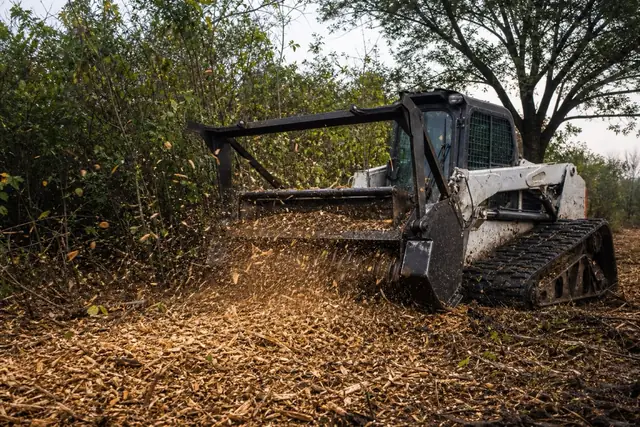
Bayshore Land Clearing puts Pasadena property owners in front of a local land clearing contractor for forestry mulching in Pasadena and the bayshore cities around it.
On the Pasadena prairie, forestry mulching earns its keep against exactly the vegetation this side of Harris County grows best: Chinese tallow that colonizes any idle acre, yaupon that knits itself into a wall, and the huisache and ragweed that fill in between. A drum or disc mulcher on a tracked carrier shreds all of it where it stands, working from the top of the stem down, and leaves the parcel carpeted in chips instead of stacked with debris.
Skipping the burn pile is not a small convenience here. Texas Commission on Environmental Quality rules make open burning of cleared vegetation a non-starter inside incorporated cities, and even outside city limits the notification requirements and periodic bans complicate scheduling. Mulching closes that entire question — the material never leaves the ground, so there is nothing to burn, permit, or truck up Highway 225 to a disposal yard.
The chip blanket also happens to be the cheapest erosion control a flat clay parcel can get. Gulf Coast storms drop rain in violent installments, and bare gumbo clay seals and sheets water almost immediately. A few inches of shredded tallow and yaupon holds the surface together, shades out part of the regrowth flush, and slowly feeds organic matter into soil that is notoriously short on it.
Reading the clay before the machine unloads
Scheduling is half the craft of mulching around Pasadena. The near-black vertisol clays mapped across this coastal prairie — the Lake Charles series is the local signature — swing between two personalities. In a dry late summer the surface bakes hard and cracks wide enough to lose a phone in, and a 15,000-pound tracked machine crosses it without leaving a mark. After a wet stretch the same ground smears, ruts, and cakes onto tracks until the machine is fighting the parcel instead of the brush.
An operator who works this ground checks the recent rainfall record from the National Weather Service Houston/Galveston office before committing a date, and will sometimes ask to slide a job a week to catch the dry window. That patience shows up in the finished product: a mulched parcel with no ruts to regrade and no smeared clay to repair costs less in total than a fast job done in the mud.
What a mulched acre looks like six months later
The honest part first: mulching is a cutting method, not an eradication method. Tallow and yaupon both re-sprout from cut stems, so an untouched mulched parcel will show green shoots by the next growing season. The difference is what those shoots come up through — a chip layer that slows them, on ground you can now walk, mow, or spot-treat. The Texas Invasives program documents why follow-up matters most with tallow, which regrows faster than nearly anything else on the prairie.
Owners who want the parcel to stay open usually pair the first mulching pass with a simple maintenance plan: an annual bush-hog pass, or targeted treatment of cut stumps at clearing time. Guidance published by Texas A&M AgriLife Extension covers both approaches, and a quote through this site can be written either way — one-time knockdown or knockdown plus the plan that keeps it down.