 Bayshore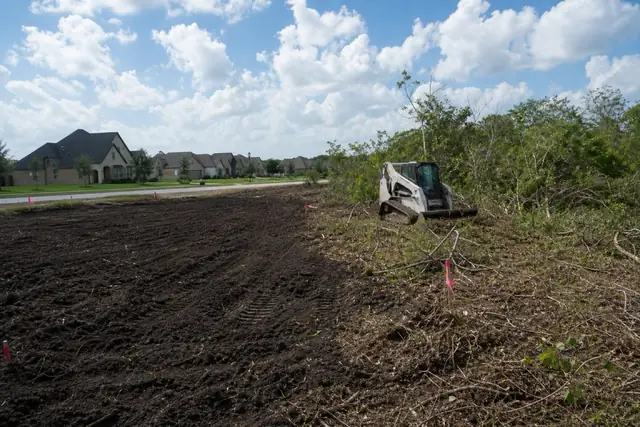

Bayshore Land Clearing puts Pasadena property owners in front of a local land clearing contractor for lot clearing in Pasadena and the bayshore cities around it.
Lot clearing on the southeast side of Houston comes in two flavors. The first is the infill lot — a platted parcel in Pasadena, South Houston, or Deer Park that has sat vacant long enough to grow a tallow grove, bought by someone ready to build. The second is the maintenance clear: an inherited or investment lot the city has started sending letters about. Both end the same way, with the parcel taken down to clean, workable ground, but they are scoped differently and priced differently.
A build-ready clear goes further than a mow. Vegetation comes out including stumps within the future slab and drive footprint, surface debris and old fence remnants get pulled, and the ground is left rough-graded so the dirt contractor who follows isn't paying to redo the clearing contractor's shortcuts. Survey pins are located before machines move and flagged so they survive the job — replacing a destroyed corner monument costs real surveyor money.
A maintenance clear optimizes for economy instead: mulch or mow everything to grade, leave the chips as ground cover, and set the lot up so a cheap annual pass keeps it clean. On a block where neighboring parcels carry seed-source tallow, that annual pass is not optional, and an honest contractor says so up front.
What 'buildable' means on Pasadena clay
Clearing is the first line of a dirt story that ends with a foundation, and on this prairie the middle of that story is always the same character: expansive clay. The local vertisols shrink and swell hard enough with moisture cycles to crack slabs that weren't designed for them, which is why foundation engineers here specify select fill pads and moisture control. The official soil descriptions — see the Lake Charles series — read dry, but 'very sticky, very plastic' is the whole engineering problem in four words.
For the clearing phase, that means two practical rules. Organic material — stumps, roots, chip layers — cannot stay under a future slab, so the build footprint gets stripped clean even when the rest of the lot keeps its mulch blanket. And the lot's drainage pattern must leave the site no worse than it was found: Harris County and the cities enforce that principle because on flat ground every regraded lot changes a neighbor's water. The Harris County Flood Control District exists precisely because this prairie has no natural slope to spare.
Permits, utilities, and the boring calls that prevent expensive days
Before any machine tracks onto an infill lot, two phone habits pay for themselves. The first is the 811 locate — buried gas and utility services cross more 'vacant' Pasadena lots than owners expect, especially where a previous structure was demolished. The second is a check with the city on tree and clearing rules for the specific address; requirements vary between the City of Pasadena and the neighboring bayshore cities, and between platted subdivisions and acreage in the county.
Unincorporated pockets fall under Harris County rules, where development regulation runs through the permit office rather than a municipal code office. None of these calls is difficult; all of them are cheaper than a stop-work order with a machine on the clock. A contractor working through this site handles the locate as standard practice and will tell you plainly which questions belong to you as the owner.