 Bayshore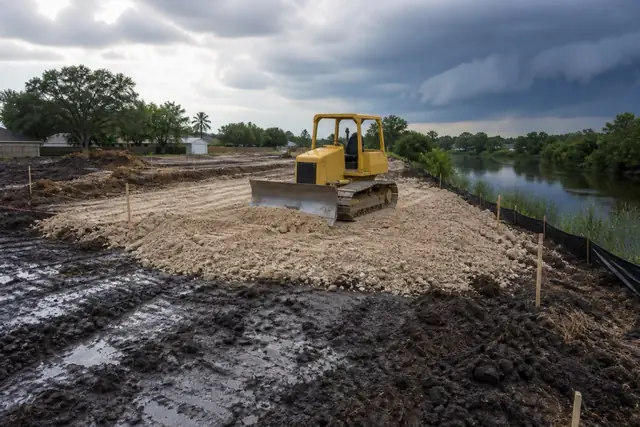

Bayshore Land Clearing puts Pasadena property owners in front of a local land clearing contractor for grading & site prep in Pasadena and the bayshore cities around it.
On land this flat, grading is really drainage design with a dozer. The natural fall across a Pasadena-area parcel can be measured in inches, so every pad, drive, and swale has to be deliberate: water must be given a route off the site — without being aimed at the neighbor's slab — or it will simply stand. Site prep here means establishing that route first and building everything else to serve it.
The sequence on a typical homesite runs: clear and strip organics, cut swales and establish perimeter drainage, then build the pad up out of the flood-nervous zone with compacted select fill, lift by lift. The native gumbo makes poor pad material — it holds water and moves with it — which is why engineered pads on this prairie are built from imported sandy loam or crushed material rather than reshaped clay.
Smaller grading calls fill out the week: backyard regrades that finally drain a swamp lawn, ditch reshaping along county road frontage, culvert sets for new driveways, and the fix-it work after years of settling around a foundation. None of it is glamorous; all of it is the difference between a parcel that works in a wet May and one that doesn't.
Building for the storm you haven't met yet
Southeast Harris County's rain arrives in bulk — roughly fifty inches a year, and the memorable storms deliver a season's share in days. The flood history compiled by the Harris County Flood Control District is required local reading: it explains why pad elevations, floodplain maps, and detention rules dominate site design here in a way newcomers from drier counties find excessive right up until their first tropical system.
Practical translation for an owner: know your parcel's floodplain status before finalizing pad height, expect the permit office to care about where your displaced water goes, and treat the weather outlook from the NWS Houston/Galveston office as part of the construction schedule. Dirt moved dry compacts to spec; dirt moved wet becomes next year's settling problem.
Erosion control on ground that won't hold still
Freshly graded clay is the most vulnerable surface on the prairie: it seals, sheets, and sends silt toward the nearest ditch with the first storm. Silt fence along the low side, stabilized construction exits, and quick revegetation of finished slopes are the standard kit — required on regulated sites under state stormwater rules administered by the TCEQ, and simply good practice on a private homesite where the 'receiving water' is your own back ditch.
Where a graded site borders a bayou corridor, the stakes rise from tidy to ecological — sediment is a direct stress on the marsh systems that groups like the Galveston Bay Foundation work to protect. Keeping the silt on the parcel is cheap insurance: a roll of fence and a seeded slope now versus a sediment complaint, a rutted bayou bank, and a regrade later.