 Bayshore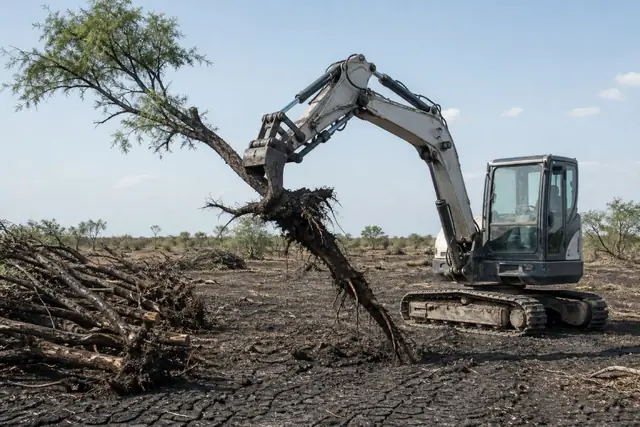
Bayshore Land Clearing puts Pasadena property owners in front of a local land clearing contractor for mesquite grubbing in Pasadena and the bayshore cities around it.
The open, drier ridges of the coastal prairie around Pasadena carry a different problem than the tallow bottoms: honey mesquite and its thorny cousin huisache, scattered like fence posts across old pasture ground. Both are legumes built for punishment — deep-rooted, drought-proof, armed — and both share the trait that makes casual removal a trap: cut one off at the ground and it regrows as a multi-stemmed shrub that is meaner to remove than the tree was.
The trap has a name: the bud zone, a band of dormant buds on the underground stem several inches below the surface. Any removal that leaves the bud zone alive — mowing, sawing, even shallow blading — triggers resprouting. Grubbing solves it mechanically: an excavator or skid-steer with a grubbing rake hooks each plant below that zone and levers the whole root crown out, taproot stub and all.
Done plant by plant, grubbing leaves the grass between trees untouched, which is why it is the standard prescription for reclaiming grazing land. The grubbed trunks windrow for later processing, the holes get knocked flat, and the pasture goes back to being pasture instead of a thorn orchard in slow motion.
The bud zone rule, and why half-measures backfire
Decades of range science in Texas converge on one line: control the bud zone or lose the fight. The species notes at Texas Invasives' honey mesquite entry and the brush-management literature from Texas A&M AgriLife Extension both document the pattern every rancher learns once: topped mesquite converts from single-trunk tree to sprawling multi-stem bush, with more stems to remove and no trunk left to grab.
Grubbing depth is therefore the whole job. An experienced operator works the rake eight to fourteen inches down depending on plant size, feels for the crown to release, and pulls it entire. On Pasadena-area clay there is a bonus: soil moisture that would stall grubbing in rockier country just makes the crowns pull cleaner here, so a slightly damp — not wet — parcel is actually the sweet spot.
After the pull: pits, brush piles, and what fills the gaps
A grubbed pasture is briefly a cratered one. Each extraction leaves a pit and a mound, and on land this flat those pits become week-long puddles unless they are back-bladed as part of the job — standing water the region has enough of already, as the flood history kept by the Harris County Flood Control District makes plain. A complete grubbing quote names the finish grade, not just the plant count.
The windrowed brush has options: mulched on site into chips, stacked for owner use, or hauled where a clean parcel is the spec — burning is generally off the table this close to the cities. And because grubbing opens bare soil patches, a quick reseed of the gaps with pasture grass or natives keeps the next wave of pioneers from claiming them; seed-mix guidance for Gulf Coast prairie is available from USDA PLANTS and county extension staff.