 Bayshore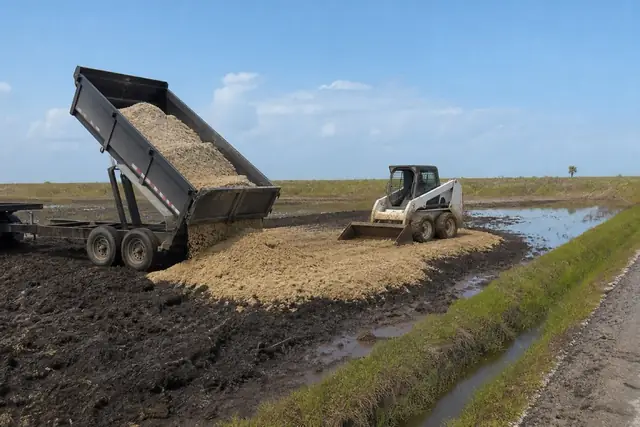

Bayshore Land Clearing puts Pasadena property owners in front of a local land clearing contractor for fill dirt services in Pasadena and the bayshore cities around it.
Flat land runs on imported dirt. Around Pasadena, fill is how low corners stop ponding, how house pads rise above the wet math of the floodplain, and how a cleared parcel becomes a parcel something can actually be built on. The service is a chain — source, haul, spread, compact — and the quality of each link shows up years later in how the ground behaves.
The material menu matters more than newcomers expect. 'Select fill' in this market means a sandy clay-loam blend that compacts predictably and drains adequately — the pad-building standard foundation engineers call for. Bank sand suits utility bedding and leveling under turf; topsoil is the finish layer for lawns and beds; and bargain 'fill dirt' of unknown origin is how people import trash, roots, and someone else's drainage problem by the truckload.
Placement is the other half. Fill dumped and left in piles settles into lumps; fill spread in thin lifts and compacted with the right equipment becomes ground. On this clay, moisture during compaction decides everything — the same material placed dry-of-optimum or soaking wet simply doesn't achieve density, which is why weather windows are part of scheduling dirt work here.
Raising grade without drowning the neighbors
On a prairie with inches of natural fall, every yard of imported fill displaces water that used to sit where the fill now sits — and that water goes somewhere. The rule enforced across the region, formalized in county and municipal drainage criteria, is that development can't worsen runoff onto adjacent property. It's the organizing principle behind everything the Harris County Flood Control District builds, and it applies at backyard scale too: raise your corner, and your plan needs to show where that corner's water goes now.
In mapped floodplain, fill placement graduates to a permitted activity with elevation and compensation rules attached — a check worth making at the county or city permit office before trucks are ordered, not after. A contractor who hauls in this county will tell you quickly which side of that line your parcel sits on.
Buying dirt like someone who's been burned
Fill quality is a trust business, and the failure mode is buried: organics and debris in cheap fill decompose and settle for years, leaving the dip in the driveway and the crack up the garage wall. Reputable sourcing means pit-run material with a known origin — and for anything structural, material meeting the project engineer's spec, sometimes with compaction testing to prove it. Soil-behavior basics for these clay-dominated profiles are laid out in the USDA's official descriptions, like the Lake Charles series, which explain why the native ground can't just be borrowed from one corner of the lot to fix another.
Volume estimating is the other place owners get surprised: dirt is sold by the cubic yard, trucks carry 10–14 yards, and a modest-sounding six-inch raise across a quarter-acre lot is roughly two hundred yards — a real convoy. An itemized quote does that math up front, separates material from trucking from placement, and prices compaction as the line that makes the rest worth paying for. Statewide water and drainage context lives with the Texas Water Development Board.